Pets = children?

Today marks seventeen weeks, and (thanks to medication) I feel okay most of the time. I gained just over a kilo this week due to eating almost exactly like a normal person.

Last Friday I met my primary midwife (I will be giving birth at a birthing centre attached to a hospital). We got on very well, and I now have an idea of how the rest of the pregnancy will go (in terms of how many times I’ll see her, when birthing classes are, etc). I have also booked my twenty-week ultrasound for early September. . . and yes, I’ll be telling everyone the gender here the following Wednesday (if I can resist sharing for that long).

Here is a list of what my cats have taught me about parenthood:

1. Life = cleaning up a variety of bodily fluids from both expected and unexpected locations.

2. Injuries in small creatures cost a lot of money, usually at 2am.

3. Biting and scratching is cute when they’re young, but if you don’t train them they will injure you regularly for the rest of your life.

4. Never forget: you are not the only one who needs food and bathroom supplies from the grocery shop.

5. Looks of scathing hatred from your dependents are part of being a parent.


The last Harry Potter film: Spoiler-free review

For those not familiar with J. K. Rowlings’ iron will: Yes it really is the last film. In a world brimming with reboots and poor-quality sequels, that alone makes the Harry Potter film series unique. And in case you’re wondering – yes, oh definitely yes. It ends.

It is possible to enjoy this film without seeing the rest – but you’ll never lose the sense that you arrived late at a party.

As the ending to an eight-film series, it is a masterpiece. We finally understand Snape, Dumbledore, and even Harry himself. Every thread is tied up, and there is no wiggle room left for further mayhem. I particularly enjoyed the epilogue.

Characterisation is done, and done just right, in just a few seconds (not just for the major characters, but for several other favourites as well). The pacing allows space for fear, despair, building tension – and even grief and laughter. Visually it is beautiful (although very dark); the effects are flawless. The acting, now that the cast is completely grown up, is great.

Don’t make the mistake of thinking this is a children’s film. It most certainly is not. There is a LOT of darkness and a lot of death – and some of the deaths are absolutely nightmare-inducing. I had my eyes closed more than once.

In my opinion, the films are better than the later books, because Harry Potter spends too much time being miserable in print (which gets irritating), and that is cut from the films. The plots do tend to be rather squashed, but oh well. The one flaw I could find in this film was one I was expecting from having read the book. In my opinion, although it has several functions, the “white room” scene is just. . . a bit silly. Everything that it does could be done elsewhere.

It did give Harry some great heroic moments, though.

Speaking of which, that is a particular strength of the film: badass moments. There are lots of them, and they are all done very, very well.

Do see the film on the big screen if you can (like I even need to tell you). There will never again be an eight-film series done this well.

Kitten on Fire

Ana, the younger (and longer-haired) of my two cats, is definitely not the intellect of the family. She also loves  extreme heat. The other cat, Indah, finds this heater too hot to touch. Not so with Ana:

We also have a single fan heater, which is highly inefficient but great for spending thirty seconds warming just your feet. Since it glows prettily, this is a favourite for the beautiful Ana (we all look best under the gentle glow of firelight, real or simulated). And so it was that I turned on the fan heater and rather pointedly put my feet very close to it, so Ana could not lie down and block the warm air.

No problem for a cat, of course: she simply squeezed herself, snake-like, into the miniscule gap. Her fur tickled my feet pleasantly, so I didn’t stop her.

Not until I saw the smoke.

My first thought was that the heater, effectively smothered, was malfunctioning. I grabbed Ana away, and that’s when I realised the truth: Her far side was hot. Not merely “I’ve just been pressed up against a heater” hot, but “I’m on fire” hot. The pressure of my hand on her side put out the fire, and Ana looked at me reproachfully – as if to say, “Excuse me? That’s MY heater, and everything was going just FINE.”

We no longer leave her alone in a room if that heater is on.


Tomorrow: Spoiler-free review of “Harry Potter and the Deathly Hallows Part 2”

Turtle Publishing

No, it’s not a hip new publishing company – it’s a comment on the industry. Now sometimes publishers are slow because they simply can’t make up their minds (one of my books has been with a major Australian publisher for two and a half years, and that’s way beyond normal). But most of the time there is a complicated process from slushpile to (hopefully) acquisitions meeting to (hopefully) bookshops.

American agent Rachelle Gardner talks about it a little here.

Personally, I’d consider six months a normal wait for a yes/no response (for either the opening chapters or the full book), and one year a standard acceptance-to-publication schedule.

While you wait to hear back, here’s a picture of a cat:


Dance like THIS

Back when I was talking about the Tour de France, someone mentioned the Midnight Oil song “King of the Mountain”. CJ showed me the clip. This clip.

Watch it, my peeps – not for the song, but for the seizure-like rock moves of the lead singer. In my opinion, he and Freddie Mercury both have the gene of sheer attractiveness-defying rock and roll awesome.


The best part? That man now holds a prominent position in the Australian Federal Government.

Dark, exquisite steampunk: Cherie Priest

Cherie Priest

(This picture was taken from wikipedia.)

“Dreadnought”

Scott Westerfeld is the king of steampunk, and Cherie Priest is the queen. While Westerfeld is quite light and fun, Priest is dark, with strong horror elements (her zombies are truly awful).

The rest of this review has been moved to Comfy Chair, where I get paid for it.

Tiny Socks

As of today, I’ve reached sixteen weeks. Mini-Me is over 11cm long (not counting his/her legs), and I could begin to feel movement any time from now on. The ondansetron is working; I am now eating a small selection of vegetables and meat, and today I was able to do some minor household chores including a load of washing that included some of these items:


Of course, now I’m exhausted and I need to lie down.

Do you, dear reader, plan to have children (assuming you don’t have kids already)? Why/why not?

I don’t think having children is a particularly rational thing to do. Theoretically, it means someone will look after you when you’re old – but that’s hardly guaranteed. You’d be better off saving your money and hiring a nurse.

Biology has a lot to answer for (and not just for “surprise” babies). The reason I want to have kids is because there’s a space in my heart for the love of a mother, and I can’t resist the urge to fill it (regardless of the cost). Also, as I’ve mentioned before, it gives my life a sacrificial focus that I crave. Raising children is one of life’s greatest, hardest, and most epic adventures.

Hobbit party

My friend Cupcake* had a birthday party on Saturday, and chose to indulge his natural hobbit-like tendencies. This meant:

1. Lots of food.

2. Lots of games.

3. He wore a charming hand-knitted waistcoat.

In a shocking twist, I actually attended. Altogether, I was out of my own house for over four hours.


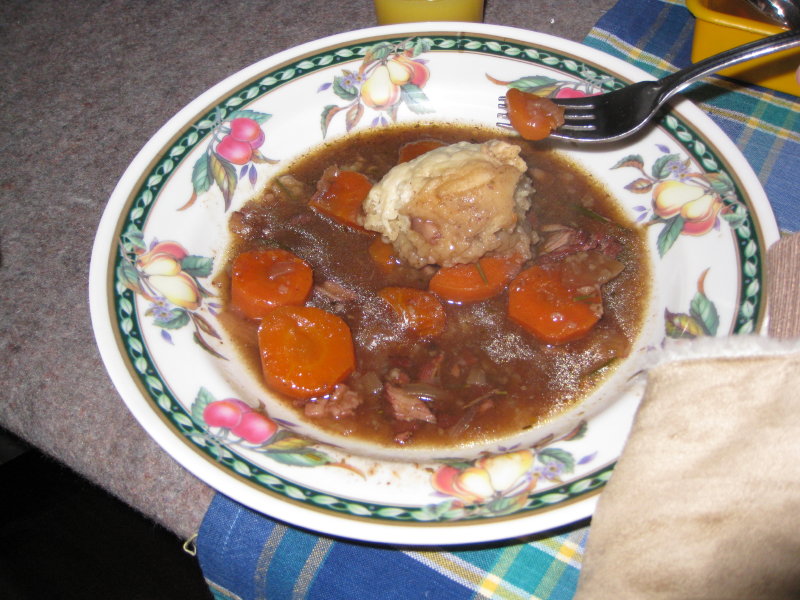
In an even more shocking twist, I ate the same dinner as everyone else. It was stew with dumplings. Since I’ve been eating mainly bread for two months, the consumption of the dumpling was unsurprising. However I was also able to eat the pieces of carrot. . . my first recognisable vegetable since May. CJ was so shocked he took a photo:


Since the party, I’ve eaten potatoes and mushrooms with no ill effects. Thank you, hobbit party, for opening the door.

*not his real name

Healing History?

A few weeks ago, I blogged about the Sydney City Council voting to change official wording in order to acknowledge that Europeans didn’t “settle” in Australia – they invaded an occupied land. It bothers me that so much of the Western world is still richer than the rest because of similar acts that took place (and in some cases are still taking place – eg the steep interest on third world debt) around the world.

Which begs two questions: Are we eventually going to pay for what our ancestors did? And – is there any way we can avoid paying that price?

I think that history tends to even itself out, and no-one stays on top forever. As someone who is definitely living at the sharp end of the wealth pyramid (not me personally but certainly my lifestyle, city and country), this is a worry.

I think it’s often justice that arises to topple the unfairly rich – so I have a theory that if the rich turn around and start actively seeking real justice themselves then maybe they won’t get brought down after all.

It starts with honesty – which can cost a great deal. When I heard (several years ago now) that the Timor Timur government was offering amnesty for the crimes committed during twenty-five years of violence, I was so impressed I wrote a story about it, which is available on a podcast here. It is M-rated, and thus goes under the name Felicity Bloomfield. (I visited Timor Timur briefly when it was under transitional UN administration.)

I also admire Germany for hating Nazism more than any other place on Earth. And I admire Japan for not hating the West for dropping two nuclear bombs.

After honesty comes active compassion and the restoration of justice. But that’s the point where my imagination shorts out.

Do you think the West is doomed to fall? If so, do you think it can be saved?

What is steampunk?

To me, the question is simple. Steampunk is fiction inspired by the Victorian era (generally featuring steam technology) – and by “inspired by” I mean it is always deliberately anachronistic (especially in the area of fantastical tech). It is used to cover clockpunk (same thing, but pre-Victorian, when clock technology was the wonder of the age), and dieselpunk (post-Victorian, with lots of diesel tech especially zeppelins).

Here is an article on someone else’s take – featuring lots of great quotes. I’ve included this one because I agree with it:

Steampunk simply embodies a time and a place. The time… the late 19th century. The place… a steam powered world, where air travel by fantastical dirigibles is as common as traveling by train or boat (or submarine). A place where national interests are vastly different than our own version of history. A place where the elegant and refined are as likely to get pulled into a grand adventure, as the workers, ruffians, and lower classes. A place where the idea of space travel is not so far fetched. A place where lost civilizations are found and lost again. A place where anything is possible, and science can be twisted to meet ones own ends. That to me is the essence of Steampunk. It can have political overtones and commentary, or it can be straight escapist fiction. Either way, if it meets these criteria. It is Steampunk.

:-Joshua A. Pfeiffer a.k.a. Vernian Process

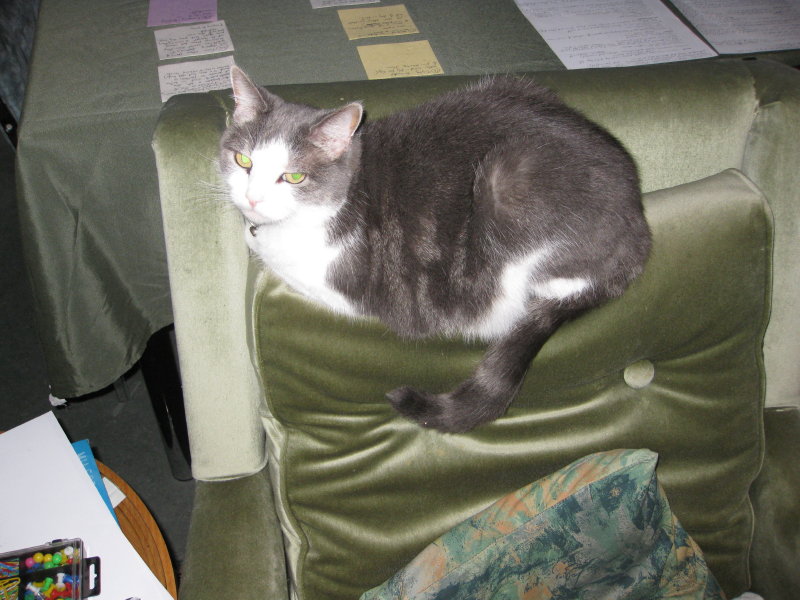
And here for your delectation is a slightly clockpunk (yes the clock is real, the entire table was made by hand, and it works) photo of my cat:

How not to begin your book

Here and here are two articles on book openings that are way, WAY overdone. Ooh! And here‘s another.

I’m guilty of a prologue or two, and the very first book of my children’s trilogy opens with the character waking up. But none of my characters ever, ever look in a mirror and describe what they see. Ugh!

And here’s a pretty (perturbed) kitty for this week:


“My Family and other Animals” by Gerald Durrell

As fiction, this book would be hilarious but too riotously fun and absurd to be believable. Since it is the autobiographical account of the Durrell family’s five years in the mad Greek island of Corfu, it is just a brilliantly funny book.


Gerald was around ten years old at the time, and obsessed with all creatures – snakes, scorpions, magpies, dogs, beetles, geckos, trap-door spiders – everything. It was an obsession that remained – you may have heard of his wildlife preserves and/or documentaries.


The peculiar characters of the island (and, more importantly, of the Durrell family) are brilliantly realised in all their glory.


Rating: G


It’s very difficult to describe the book, so I’ll just give you a glimpse and let you see for yourselves. This takes place on a dull afternoon when the entire family was ill except Larry (a WRITER), who was feeling morose. . .


At length, glancing moodily round the room, he decided to attack Mother, as being the obvious cause of the trouble.

“Why do we stand this bloody climate?” he asked suddenly, making a gesture to the rain-distorted window. “Look at it! And come to that, look at us. . . Margo swollen up like a plate of scarlet porridge. . . Leslie wandering around with fourteen fathoms of cotton wool in each ear. . . Gerry sounds as though he’s had a cleft palate from birth. . . And look at you: you’re looking more decrepit and hag-ridden every day.”

Mother peered over the top of a large volume entitled Easy Recipes From Rajputana.

“Indeed I’m not,” she said indignantly.

“You ARE,” Larry insisted; “you’re beginning to look like an Irish washerwoman. . . and your family looks like a series of illustrations from a medical encyclopedia.”

Mother could think of no really crushing reply to this, so she contented herself with a glare before retreating once more behind her book.

“What we need is sunshine,” Larry continued; “don’t you agree, Les? . . . Les? . . . LES!”

Leslie unravelled a large quantity of cotton-wool from one ear.

“What d’you say?” he asked.

“There you are!” said Larry, turning triumphantly to Mother, “it’s become a major operation to hold a conversation with him. I ask you, what a position to be in! One brother can’t hear what you say, and the other one can’t be understood. Really, it’s time something was done. I can’t be expected to produce deathless prose in an atmosphere of gloom and eucalyptus.”

“Yes, dear,” said Mother vaguely.

“What we all need,” said Larry, getting into his stride again, “is SUNSHINE. . . a country where we can GROW.”

“Yes, dear, that would be nice,” agreed Mother, not really listening.

Mini Big Nose

Still very sick. The last time I had a non-nauseous moment was Sunday, and my ability to eat food isn’t improving at all. I did a little research on ondansetron (Ondaz Zydis) and discovered there are no known issues with taking it during pregnancy (the crucial word being “known” – it has been tested on animals, but of course you can’t test these things on humans). I’ll probably start taking it again tonight.

Here are my predictions about Mini-Me’s future:

Big nose (both sides of the family, several generations)

Intelligent (both sides of the family, several generations)

Uncoordinated (both sides of the family)

Introvert (both sides of the family, and all the grandparents)

Vulnerable to cancer (CJ’s side) and mental illness/dementia (my side).

Will be born with either dark hair (my side) or white-blonde hair (CJ’s side), and will probably have blue or green eyes.


YA steampunk: The Sky Village

“The Sky Village” by Monk & Nigel Ashland


It hurts my brain trying to figure out if I love or hate this book. The front cover and the title location – a village of hot air balloons strung together – appear steampunk, but it’s not steampunk. It’s post-apocalyptic YA.

The rest of this review is at Comfy Chair, where I get paid for it.

Yell for Cadel

I’m breaking with my usual tradition of linking you to writing tips each Saturday, but it’ll be back next week.

Here‘s a cracked article on the Tour de France. Most of it doesn’t apply to Australia, because our commentators are refreshingly respectful and classy, and tend to actually talk about what’s happening in the race. #1, however, is utterly and frighteningly true. This article is PG/M (the site is often MA or more), and has a picture of a man in a mankini. Don’t say I didn’t warn you.

Stage 18 (I’m yet to watch 19) was seriously epic. I’ve spoken before about attacks, when one man races ahead of the pack. Most of the time they fail, especially if the attacker is a big name – no-one will let them get away. But they’re also the only way for the big names to break away and get ahead, so they happen a lot towards the end of each stage of the race. They’re utterly exhausting for everyone, especially the attacker, who has to pull sudden strength out of nowhere – and abandon the aerodynamic cooperation of the pack if he actually succeeds.

In Stage 18, Andy Schleck (who came second last year – by 23 seconds) launched an attack. . . fifty kilometres before the end of the race. It was an insane move, and surprised everyone so much that he got away. He rode with inhuman speed past THREE other smaller (non-threatening but startled) groups, pausing only to work with two team-mates who had been sent out ahead in deliberate preparation. His largely solo journey lasted over an hour – 9% of it uphill. In the Alps.

At one point, he was FOUR MINUTES ahead of the pack, and the virtual leader (after beginning the day in fourth place) of the entire Tour. He then went and won the stage, proving that the most outrageous gambles sometimes pay off.

Meanwhile, the pack slowly realised they were screwed – Andy really was going to win the entire stage on his own, and possibly the Tour de France as well. Unfortunately, despite attempts to share the load, they were simply too exhausted to catch up (ie when twenty men attempted to work together to match the speed of Andy Schleck – they failed). Finally Cadel Evans accepted that he was the only one with any strength left, and for the last 11 kilometres he bore the entire weight of the group, and slowly chipped seconds away from Andy. He singlehandedly cut Andy’s advantage in half, keeping himself as a contender for first place.

When Cadel pulled out all the stops and rode his desperate mano a mano race, more and more champions dropped off the back – including Alberto Contador (last year’s winner). One of the tiny handful that remained was Thomas Voeckler, who was meant to barely survive the intense mountain stages.

Instead, on the second last mountain stage of the Tour, he managed to keep up with Cadel – and thus keep the yellow jersey for one last excruciating day. By fifteen seconds.

And thus Stage 18 had three winners.